
i wanted to run a social experiment every month this semester.
the goal isn’t data, exactly, though i’ll collect it. it’s more that i have questions about people, about the gap between what we think we’re doing and what we’re actually doing. and i think the only honest way to answer those questions is to build little situations, watch what happens, and write it down.
january’s question: can you weaponize your own psychology against yourself to wake up in the morning?
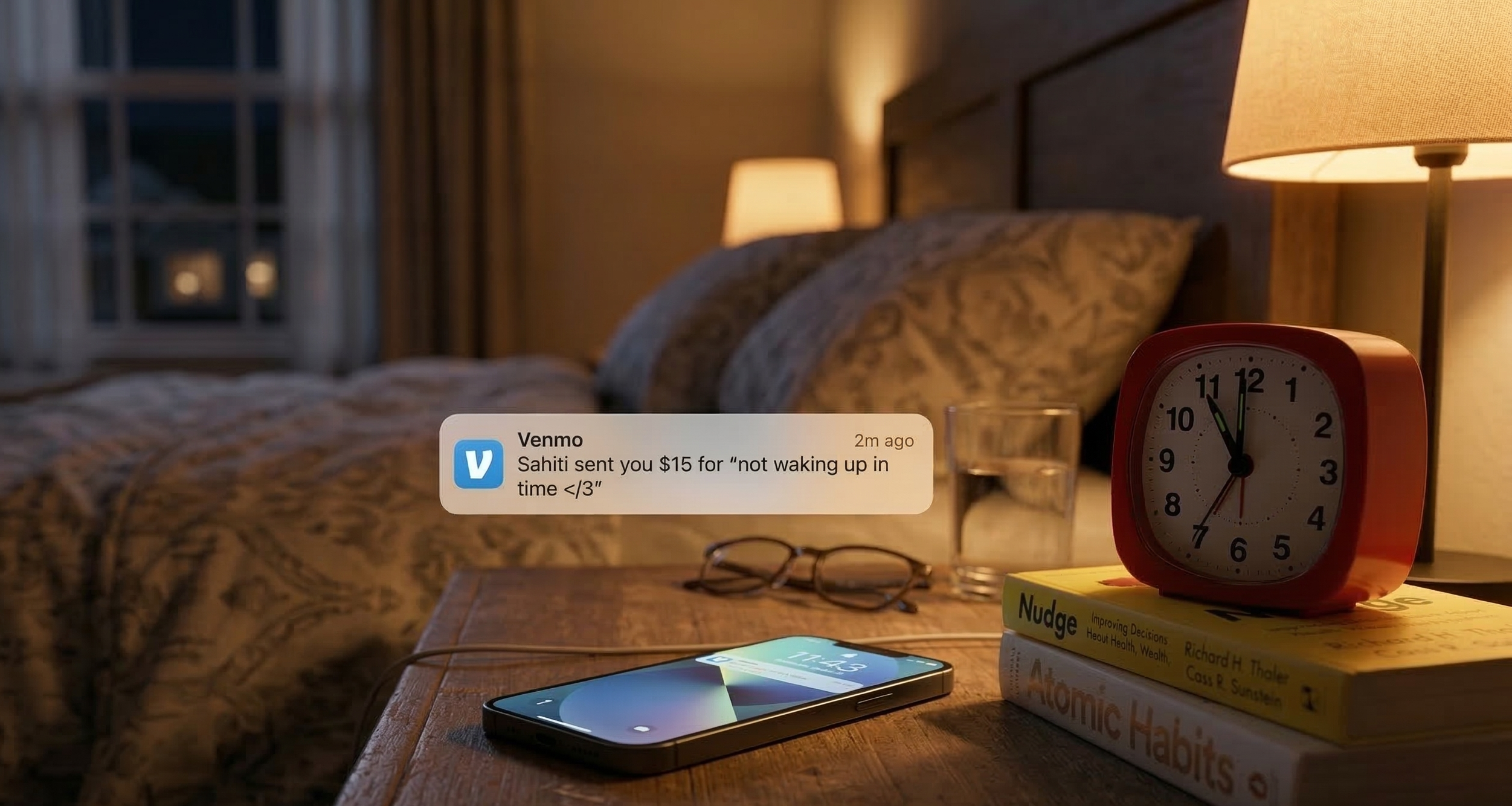
i read nudge by thaler and sunstein over break. it’s a book about choice architecture — the way the structure of a decision shapes what we choose, usually more than our actual preferences do.
the part that stayed with me was a story about a graduate student who couldn’t finish his dissertation. he knew he needed to. the financial stakes of not finishing were enormous: another year of tuition, lost income, all of it. and still, every day, he procrastinated.
so he did something drastic. he wrote several $100 checks to his dissertation advisor and handed them over. the deal: if he missed his section deadlines, the advisor would cash them. and not just cash them. use the money to throw a massive party and invite everyone in the department, except him (oh, the horror).
it worked perfectly.
not because $100 outweighed the cost of an extra year of school (it didn’t, not even close). but because the $100 was immediate. the party was vivid. the abstract future consequence of failing your dissertation lives somewhere theoretical in your brain. the very specific image of your colleagues drinking wine you paid for, while you sit at home, does not.
that’s what thaler and sunstein call a commitment device. your rational self (the planner) sets up a trap for your impulsive self (the doer) before the doer gets a chance to make excuses.
i wanted to test if it could work for something simpler and more universal. i wanted to test it on waking up.
the setup:
here’s the thing about waking up that i think is genuinely interesting, and not just a productivity complaint.
every night, you make a promise to yourself1: “i’m waking up at 8. i have things to do. this time i mean it. and you believe yourself.” the planner in you is completely sincere. they have a whole vision of the morning: a Pret chai run, emails, maybe a gym run before class. they set three alarms just to be safe.
and then morning comes, and the doer shows up. and the doer is a different person entirely. they have no memory of what the planner wanted. they live only in the present tense, and the present tense says the bed is warm and the alarm is offensive, and fifteen more minutes won’t actually hurt anything.
thaler and sunstein call this the planner-doer problem. it’s not that you’re lazy or undisciplined. it’s that you’re two different agents sharing one body, with different goals and different time horizons, and the doer has home field advantage every morning because they’re the one who’s awake.
the insight is that willpower alone can’t fix this. you can’t out-decide your way out of a structural problem. what you need is to change the structure.
so in january, i ran an experiment and called it wake or pay. full instructions.
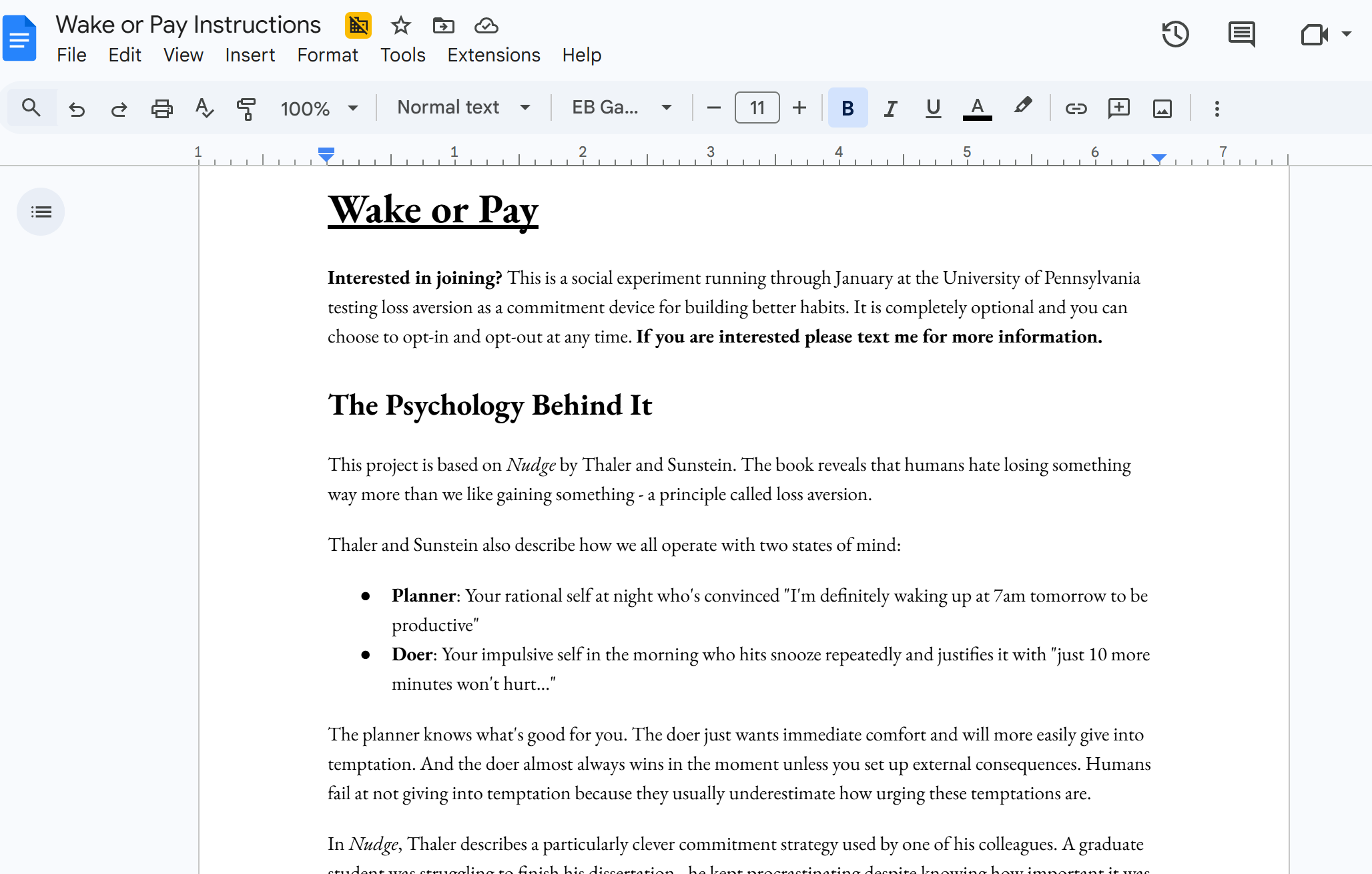
the premise: every night before bed, you set your target wake-up time and a margin, a fifteen-minute buffer for real life. then you send money to your accountability partner via venmo or zelle. real money and enough that it actually hurts, not a token amount you can rationalize away. something that, when you’re half-asleep and weighing your options tips the scales.
the next morning, you have two options:
-
wake up by your time (+margin): you get the money back immediately.
-
don’t wake up: your partner keeps your money. no questions asked and no getting it back.
the pairing system mattered too. everyone was arranged in a chain. person a sends to person b, person b sends to person c, person c sends back to person a. that way everyone has skin in the game in both directions. you’re not just accountable, you’re also holding someone else accountable. in other words, you’re a link not a passenger.
every night was a fresh commitment. new wake-up time, new amount, optional opt-out if you genuinely didn’t care about that particular morning. the idea was flexibility without escape hatches. you could opt out, but you had to do it consciously, the night before, not when the alarm was going off and your judgment was compromised.
one thing was clear from the start: this only works if you actually want it to. if someone else is pressuring you into it, or if you don’t genuinely care, the device fails. you’ll just lose money and feel resentful. the planner has to actually be invested.
what happened was mostly what i expected, and then some things i didn’t.
it worked. the chain held. people woke up. the threat of losing real money does something to your brain that no amount of good intentions the night before can replicate. the consequence was immediate, concrete, personal. exactly what the dissertation story predicted.
but the calibration was more personal than i expected. ten dollars wasn’t enough for everyone. some people needed fifteen before the alarm felt like an actual threat rather than a suggestion. the number isn’t objective. it has to hit your specific pain threshold. too low and your brain finds a way to rationalize it. at the right number, the rationalization fails. your doer does the math and gives up.
i woke up before my alarm the first morning. not because i was rested.
out of fear.
i’m still not entirely sure how i feel about that.

the results:
i personally opted2 in for 13 nights across january. here’s what actually happened:
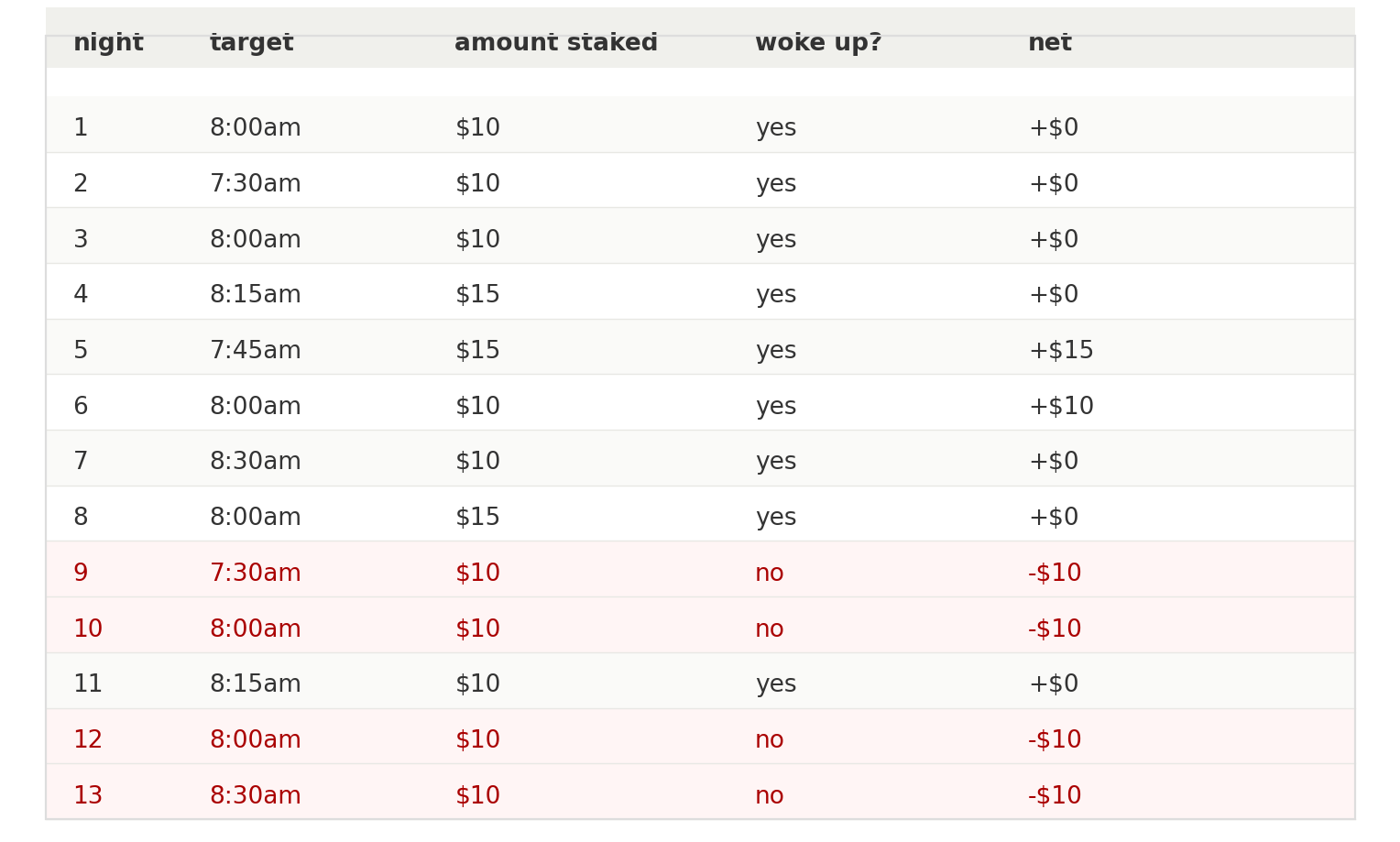
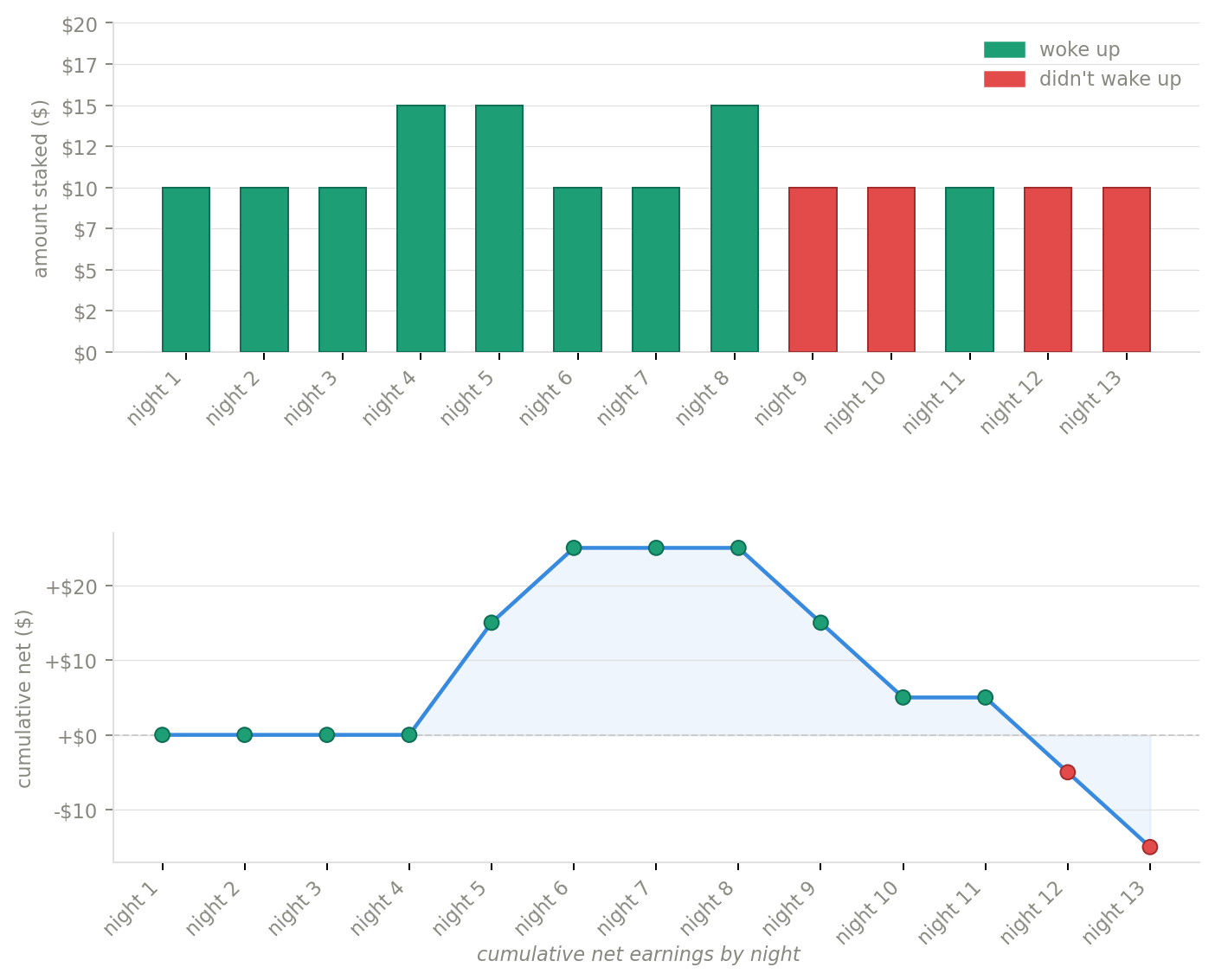
9 out of 13 nights, i woke up on time.
the first eight were nearly perfect. the chain was intact, the stakes were real, the device was working exactly as designed.
then something shifted. the last five nights tell a different story, and the pattern in the data isn’t random.
i noticed two main things happened that broke the experiment in genuinely interesting ways.
the first: at some point, it was just me and my roommate in the chain that night. two people, with the same amount going back and forth.
and i looked over one morning and saw her still asleep3.
and i stayed in bed.
not because i forgot about the experiment but because when i did the math (surprisingly rational while still half asleep) we were a closed loop. whatever they sent me, i sent back. whatever i paid out, returned. net zero. the asymmetry was gone. without asymmetry, there are no real stakes. the accountability had structurally evaporated, not because we stopped caring, but because the architecture we were depending on had quietly collapsed.
the commitment device only works when the chain is real. when losing actually means losing. the moment it becomes theoretical, the doer runs the numbers and wins.
the second: house money.
at some point i’d made a net fifteen dollars from other people not waking up. which felt like a small victory. but once i had that buffer, the calculus shifted. losing ten didn’t feel like losing ten anymore. i had cushion. the fifteen i’d earned from other people’s snooze buttons made my own potential loss feel abstract again.
it’s a poker concept. house money is chips you’ve won at the table, and people consistently treat them differently than the chips they came in with. spend them faster. risk them easier. the money doesn’t feel as real because it was never really theirs to begin with.
my brain did the same thing with my sleep schedule. i had a fifteen dollar buffer, which meant losing ten felt like losing five of money that was barely mine anyway. and suddenly the bed was warm again and the math had changed.
i had given myself an escape hatch without realizing it.
 few benefits of waking up on time: philly sunrise at 6:30 AM
the conclusion:
the commitment device works when it’s sharp. when the stakes are concrete and the chain is solid and there’s no psychological exit left open.
the moment you can tell yourself a story about why the loss doesn’t really count, because it’s house money, because the loop is closed, because it’s only ten dollars, you’ve already lost. the doer is a narrative animal. give them a story and they’ll run with it all the way back to sleep.
what i keep coming back to is how structural this all is. the experiment didn’t succeed or fail based on anyone’s willpower or character. it succeeded when the architecture was intact and failed when it wasn’t. we didn’t become different people. the situation changed and our behavior followed.
and i think that’s the part that’s hardest to sit with. we like to believe that if we just wanted something badly enough, we’d do it. that discipline is a character trait you either have or are building. but january made me think it’s less about wanting and more about engineering. the planner can want all they like. if they haven’t set up the right conditions the night before, the doer will undo the decisions by 8am.
i also think about how much of daily life runs on exactly this kind of unchecked autopilot. not just waking up. the things we say we care about, the habits we claim to be building, the person we’re pretty sure we’re becoming. how much of that holds up when the architecture isn’t there? when no one’s watching, when the stakes feel abstract, when there’s a story available that makes giving in feel reasonable?
the answer, i think, is less than we’d like.
the planner in me wants to end this with something clean. a lesson, a takeaway, a framework for next time. she’s already drafting it.
but the doer is waking up soon, and she doesn’t read essays.
sahiti
upenn, january 2026


